

Why we don’t change naturally: How blind spots keep you stuck
Posted: January 29th, 2026
by Matthew Strebinos
(Clinical Registrar), MPsych(Clin), BPsych(Hons)
Why we don’t change naturally: How blind spots keep you stuck
One of my main fascinations since I was a young child centred around why people believe what they believe. Therefore, the study of psychology was a godsend for me when learning about formulations. However, what has piqued my attention more, especially when learning how to help my clients actually improve their lives (rather than pure understanding of belief origin), is around why people seem to maintain such beliefs (particularly unhelpful ones).
This brings me to what I would consider to be one of the most crucial components in creating belief change, which is understanding mental filtering and how it creates blind spots.
Humans develop many destructive beliefs that wreak havoc on their lives, like believing you are a failure, incapable, or even just bad, after being criticised by others, failing tests, or scolded for dropping a plate. Crucially, these beliefs form in moments when we lack contextual understanding or awareness: a parent may be suffering from their own mental health issues and letting it out on you; we may have been much younger than other kids in our class and therefore lacked the extra six months of brain development to help us learn at the same rate; or we may not have had the knowledge to understand we weren’t supposed to have the fine motor skills required to carry plates at five years old. It may seem obvious, yet in the moment the picture was incomplete, and we drew conclusions with only part of the story.
That’s the nature of a blind spot. It’s not that we’re careless or unaware; it’s that our mind is limited and it can’t always account for everything, especially when we are young and do not yet have such capacity.
Then why, after years have gone by, do we still not use hindsight easily? Well, that is why I bring to you the understanding of scotomas.
What Are Scotomas?
Have you ever looked back on a situation and thought, “How did I not see that at the time?” Maybe it was a pattern in a relationship you didn’t recognise, a habit that kept you stuck, or a thought that felt like fact. This perfectly highlights the impact of a scotoma.
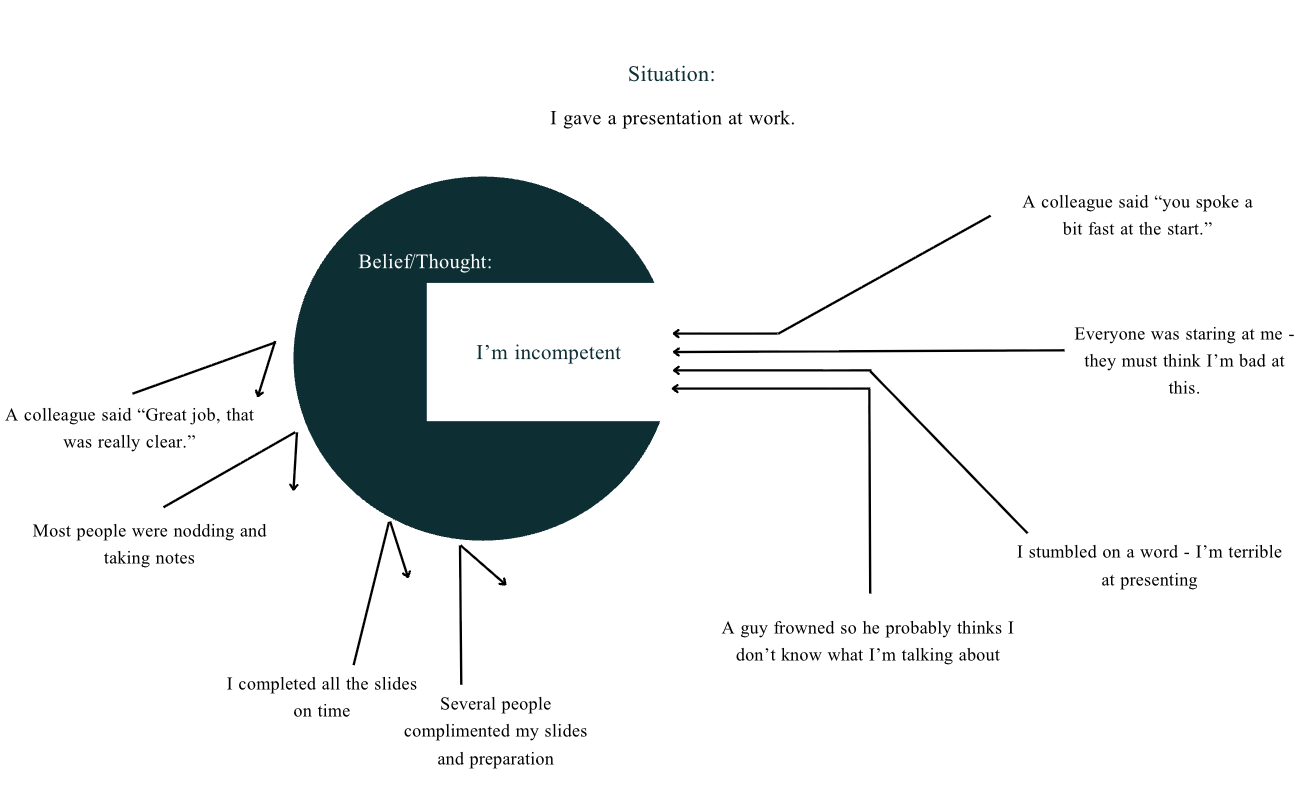
A scotoma (pronounced sko-toe-ma) is a psychological blind spot or a gap in awareness caused by mental filtering. In short, our brains commonly only see what they are looking for. It’s not that the information doesn’t exist; it’s that our brain doesn’t recognise it or automatically edits it out because it feels inconsistent, uncomfortable, or irrelevant.
These filters serve a biological purpose by protecting us from overload. However, this process can be harmful, as we may end up twisting or dismissing evidence that contradicts our beliefs, thoughts, or assumptions, which can reinforce or strengthen the very beliefs that hold us back.
Functionally, there are two main types of blind spots:
Things we can’t see
These are the elements, patterns, behaviours, or assumptions that operate automatically and outside of our conscious awareness. We can’t question what we don’t pay attention to.
For example:
You may assume you’re “not good at public speaking,” without recognising times when you’ve successfully presented ideas.
You might react defensively to criticism, without understanding this is a learned response to previous criticism that actually put us in danger.
These blind spots aren’t about ignorance; they’re because our brain is looking to confirm what we already think. Our brain simply doesn’t register these patterns until something triggers awareness.
Things we don’t know
These are the gaps in experience, knowledge, or understanding that influence the beliefs we form. They often arise from avoidance, limited exposure, or circumstances outside our control. The main thing here is to understand context!
For example:
Assuming you’ll never enjoy a certain hobby because you’ve never tried it.
Assuming someone doesn't like you because they looked at you funny (without realising they have had a bad day)
It is also important to briefly mention how these filters are not random. They usually follow deeply held patterns of beliefs about ourselves, others, and the world (schemas), which usually formed early in life when we had limited context, power, or understanding (stay tuned for more information on schemas).
Once a schema or belief forms, it acts like a lens through which we see ourselves, others, and the world. It shapes how we interpret experiences, what we pay attention to, and what our mind filters out. This is where scotomas and filtering come in. Beliefs are maintained via filtering / automatically blocking, distorting, or minimising information that doesn’t fit with what we already believe. For example, if you have a belief that romantic partners will leave you, you may become very upset when your partner goes to the shops (thinking this is a form of abandonment). While you can see and know they are going to the shops, your mind is processing this information in accordance with a previously held belief or schema (abandonment).
In other words, schemas create the belief framework, and filtering maintains the belief by creating blind spots that keep that framework intact.
Why This Matters
Mental filters quietly shape our thoughts, emotions, and behaviour. They influence what we pay attention to, what we ignore, and how we twist information to fit previously held beliefs. Over time, these scotomas can keep us stuck in unhelpful cycles: replaying old stories, assuming things “always go this way,” or discounting progress we’ve made.
When we start to notice what our mind filters out, we expand our field of awareness. Suddenly, we have more data and context to work with, and that means more choice, flexibility, and compassion for ourselves.
Humans are not random. We are all a culmination of our experiences, modelling, teachings, and memories.
Full awareness is often where change begins.
What We Can Do
Start by asking gentle, reflective questions that help you identify information outside of your awareness:
“If this thought wasn’t true, what would be the indicators of that?”
“Has it always been this way?”
“Am I missing something?”
“Is there a reason for why that is that I am not accounting for?”
“Does it always have to be this way?”
These questions disrupt the automatic filtering process and invite curiosity rather than self-criticism.
From there, behavioural experiments can be powerful. Instead of debating your thoughts, test them. Collect evidence through lived experience. What actually happened (was your prediction true?). Notice what your mind pays attention to and what it leaves out.
As you begin to contextualise your evidence (seeing the bigger picture rather than one filtered view), your psychological “vision” becomes clearer and more balanced.
How Therapy Helps
Therapy offers a structured space to explore these mental filters safely. A psychologist helps you through a process of collaborative discovery in order to uncover what may be outside of awareness.
Evidence-based approaches like Cognitive Behavioural Therapy (CBT) and Schema Therapy help expand awareness to see where beliefs were formed, bring flexibility, and perhaps even full belief change.
Begin Your Next Step
At Elevare Psychology and Wellbeing, our work is designed through progress and purpose. We focus on helping you understand your own filters and find clarity in the areas that have felt hidden so you can respond to life with insight, not autopilot.
If you’re ready to explore the blind spots and mental filters that might be shaping your story, we’re here to help.
Book an appointment with Elevare Psychology and Wellbeing and take the next step toward seeing yourself and your world more clearly.